Some thoughts after having been working in AI for a bit here and what mental model I’d carry if I were just entering the workforce:
R. Buckminster Fuller described exactly who will win in the age of AI waaay back in the 1960s. He called them The Great Pirates.
His view in “Operating Manual for Spaceship Earth” was that for centuries the world was run from the sea by men holding three big advantages nobody on land had: they saw the whole planet while everyone else lived on local maps, small, limited views. Also, they mastered a broad and deep array of disciplines: navigation, astronomy, shipbuilding, trade, the psychology of a crew, and whatever was needed given the situation. And their arena was the open ocean, where no kingdom’s law reached. They had to be highly adaptable.
Their sharpest move was arguably inventing specialists. They pushed kings to build schools that trained smart but narrowly informed navigators, gunners, economists – while the pirates kept their broader, deeper, more powerful expertise.
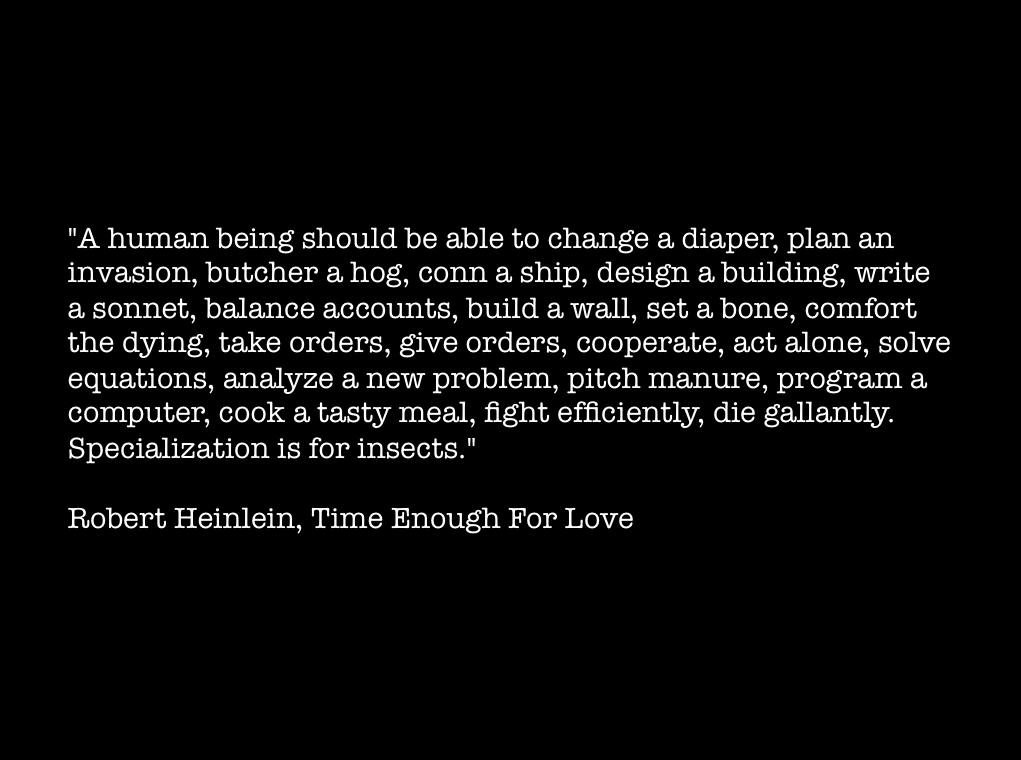
Fuller called specialization, “A form of slavery dressed up as prestige.”
The generalists stayed in command.
Around World War One, the Great Pirates went extinct. Technology was mysterious and moved into electromagnetics, chemistry, metallurgy, and more and men who ruled by what they could see and touch couldn’t follow so were left behind.
For a little while, the specialists inherited some control. For a century or so, being an expert in a specific area was the safe career.
AI closes that century. Specialist knowledge is abundant now.
What’s scarce is the pirate’s diverse set of skills: the whole-system view, fluency across ten disciplines without a degree in any of them, coupled to the nerve to work in constant ambiguity where the rulebook hasn’t been written yet.
Buck wasn’t the only one who felt this way.