Ahhh a relaxing sigh. Thee old game is finally fading fast.
Those detect-block-pray models we’ve leaned on for decades are slipping into quiet retirement on the shore of a small coastal town. They did their best. They kept the lights on. But the board is flipped, tables tumbled, calcified mental models are crumbling and the tide is carrying them away.
AI deception attacks are scaling at a pace that surprises even those who doubted its efficacy. Deepfake executives draining wires in real time. Agentic phishing doesn’t just copy your voice, guess your style, it clones your exact Slack vibe, your family photos, your last three meetings, and lands 450% click rates. Synthetic bots spinning full machine-to-machine fraud campaigns in minutes not hours or days.
The bad guys (and their AIs) aren’t knocking on the door anymore. They’re already inside the conversation, wearing your voice. InfoSec teams have been playing defense the old way too long, anyway tbh. Block. Alert. Hope. It worked when the threats were slower, dumber, more human. But now? Name an incumbent vendor that’s actually kept pace. The reactive, same-old stack mindset is slipping into that coastal retirement life and good riddance. Something better is emerging.
Defense-in-depth is maturing with a youthful gleam, painted with flexible, bullet-proof coatings, intelligent at last, stepping forward as the primary layer — not an afterthought, not a shiny add-on, but the first and strongest line of protection at scale. Exciting things ahead.
The evolution of Deception Technology layers is relatively young but most of us have ignored it for the past 10+ years somehow. Don’t start tinkering with canarytokens.org unless you’re curious tho because it’s addictive once you start going deeper into that mental model.
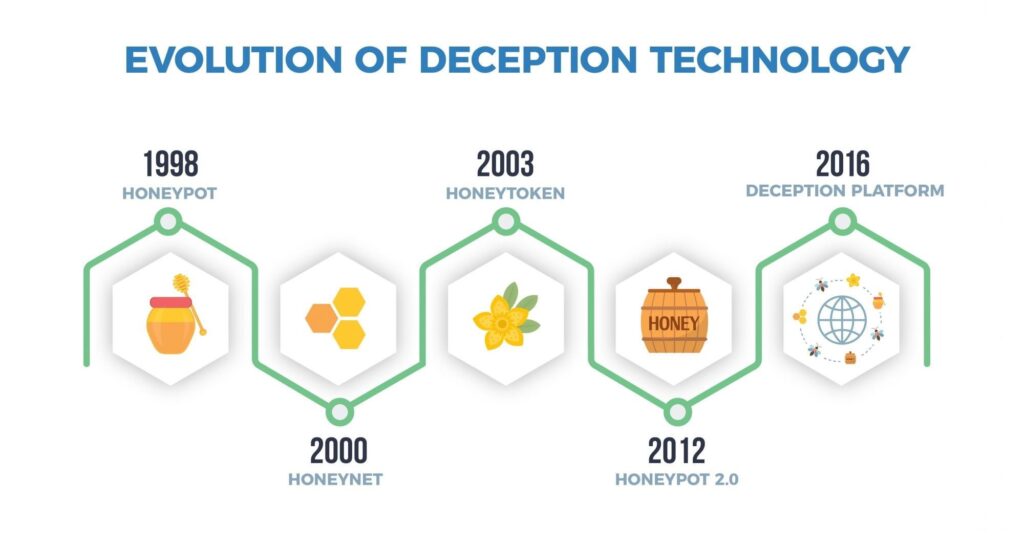
Imagine: building entirely synthetic traffic ecosystems that lie convincingly to criminals. Adaptive, generative decoys that don’t just sit there waiting to be poked. They watch, they learn, they join and they synthesize in real time. Every probe from an attacker feeds the system. Every TTP (tactic, technique, procedure) gets turned into fuel. Decoys morph, multiply, and mirror your real environments so perfectly attackers can’t tell the difference between data that matters and data designed to waste cycles.
They think they’re stealing secrets, identities. Instead, they’re chasing beautiful illusions painted just for them. They think they’re moving laterally but they’re running on a ghost treadmill. Their AI models get starved, poisoned, and exhausted while our systems quietly map every move, every preference, every tell.
It’s not science fiction it’s the next chapter. Deception tech is finally jumping the shark and it’s not just “nice to have.” It’s becoming the core of anti-fragile resilience. Truth-seeking, ludic, playful in the best hacker sense. Turn the attacker’s own curiosity against them. Waste their resources so thoroughly that the malicious models burn up in the atmosphere of #DeceptionTech, like old satellites falling out of orbit, re-entering and glowing out.
Picture the operational reality in 2027–2030:
- cloud-native synthetic layers baked into every environment
- fake APIs
- decoy identities
- dynamic canaries, honeytokens that relocate themselves the moment they’re touched
- Agentic deception engines that don’t just respond — they proactively seed false intel back into attacker toolkits, poisoning their training data at the source
- Behavioral fingerprinting + multimodal lures that catch deepfakes and synthetic personas before they ever reach a human approver
- M2M deception at crypto/fintech scale — synthetic transaction flows that look so real the attacker wastes millions in compute trying to launder shadows
The grateful part? This future doesn’t replace humans as much as it frees us, lets the parent-partner-host-hacker in each of us focus on what we’re actually good at: imagination, connection, building things that matter. The machines handle the heavy lifting, the endless cat-and-mouse.
Have you been waiting years to watch malicious models burn up in that atmosphere? How about now? The future looks as exciting as ever. So here’s the gentle wake-up call and the invitation: if your mental model still starts with “detect and block,” it’s time for that relaxing sigh. Let the old models retire to their coastal shore.
The new primary layer is already here –> intelligent, adaptive, synthetic, and ready to play 4D chess while attackers chase ghost pixels that were never real. Truth-seeking, ludic, antifragile AISEC isn’t coming. It’s being built right now, by people like you and me who see the shift. Grateful for every hacker, every defender, every curious mind that catches the gleam. L F G